
Epoxy Floor Repair
Coated floors do not all break down the same way. Hairline fractures across the finish, coating curling up off the slab and traffic lanes ground down to bare concrete each trace back to something different, and a sound repair begins by naming the real culprit. When one area has trouble and the rest of the floor is healthy, targeted work may be enough; when the bond has let go across much of the slab, starting over may be wiser. Telling those apart takes a careful look at the coating and the concrete beneath it.

The Short Answer
Damage carries clues about its origin. Chips and cracks in the coating typically come from blows on the surface or movement in the slab underneath. Peeling and lifting tell you the coating has come unglued from the concrete. Dull, stained areas develop from repeated traffic and chemical contact. Because every type of damage has its own cause, each calls for its own fix, and choosing that fix begins with an evaluation: which part of the system gave way, how much of the floor is affected and what condition the slab below is in.
Common Problems With Epoxy Floors
The kinds of coating damage an evaluation most often uncovers, and what each means.
01
Cracks & Chips
Two damage types turn up regularly. Impact damage, meaning chips, gouges and scrapes, starts at the surface whenever a dropped wrench, a rolling jack or a heavy box strikes the coating. Cracks through the finish generally begin underneath, where settling, shifting loads or thermal movement in the concrete work their way up into the coating. If the trouble is confined to a few spots and the neighboring coating still grips firmly, fixing just those spots might be workable. Your installer makes that judgment once the damage and its probable source have been looked over.
02
Peeling & Delamination
Peeling rarely stays in one place; once a coating begins to release, the failure usually spreads outward. It means coating and concrete are no longer holding onto each other, and finding out why is the heart of a repair with staying power. The root cause often lies in the original installation: slab moisture that was never tested, concrete that never got the profile the product required, or leftover coating that sat between the new product and solid concrete. Pinning down that cause is what opens the door to a durable fix.
03
Stains & Surface Wear
Scuffs, a faded sheen and discoloration from routine traffic and spills are not the same as a bond failure. A floor can look tired on top while the layers beneath stay firmly attached to the slab. In that situation, refreshing the surface with another topcoat over the intact layers could be enough. Your installer checks adhesion and looks over the coating’s general condition before recommending that option.
How Do Professionals Repair Peeling or Damaged Epoxy Floors?
Any repair begins by closely examining the existing floor. That examination shows which parts of the old coating are still bonded well, what triggered the failure and how the concrete looks where the damage happened.
Loose and lifting coating gets removed rather than covered. Areas that give back a hollow sound when tapped, or that lift off with minimal effort, have already let go of the slab, and burying them simply relocates the failure. With the failed material gone, the slab gets cleaned and roughened again so the patching product or new coating has firm concrete to bond with.
When separation is extensive, the plan can change from patching individual spots to recoating the whole floor, a call that is made only once the full scope of the damage is clear.
How well a repair lasts relies heavily on what happens to the bare concrete after the old coating comes up. Our explanation of preparing concrete for coating covers what that involves.
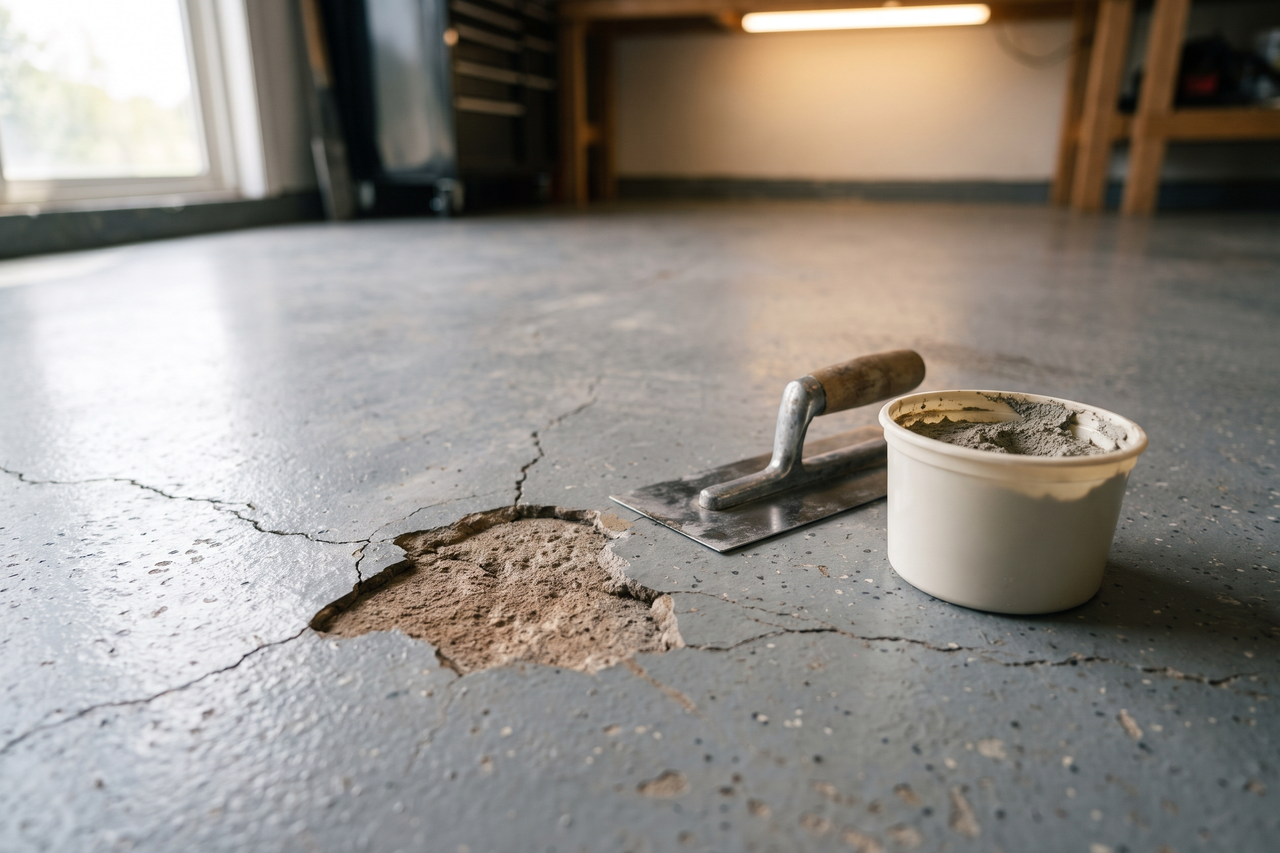
Can an Epoxy Floor Be Repaired, or Does It Need to Be Replaced?
Both repair and replacement are valid results. What decides between them is how much of the current coating remains bonded and why it failed to begin with.
Stripping the whole floor is not where the conversation starts. When the damage sits inside clear limits, say one raised section, a scatter of chips from dropped tools or a single crack that has stopped moving, fixing those places and keeping the healthy coating can be a sensible, budget-minded way to stretch the floor’s useful life.
A strip and recoat is more appropriate when the bond has failed across the bulk of the floor, when the source of the first failure was never corrected, or when the deterioration has gone too far for spot repairs to help.
Looking alone does not settle it. Tapping the surface, testing adhesion and studying the concrete in the trouble spots tell you far more than a walk across the room. If a full new floor proves to be the smarter route, our overview of how a new epoxy floor goes in describes each step of the installation.
How Much Does Epoxy Floor Repair Cost?
A meaningful repair price depends on seeing the floor in person. Repair covers a wide range, from sealing one hairline crack on a sound floor to taking a slab with adhesion failures nearly everywhere back to bare concrete and coating it again. Scope is set by the type and reach of the damage, how much coating has to come up, the condition of the slab below and the prep all of that requires.
A number quoted sight unseen does not tell you much.
What Causes Epoxy Floors to Fail, and How Can You Prevent It?
Knowing why coatings give out helps in two situations: planning a floor that has not been coated yet, and sizing up one that is already in trouble. A familiar short list of causes turns up again and again in coatings that quit early.
Improper Concrete Preparation
When failing coatings are examined, preparation is frequently the culprit: a profile too shallow for the product, contaminants left on the concrete, or an earlier coating that kept the new material away from a solid substrate. Each of these can rob the coating of the mechanical grip it needs. A floor like that may look fine at first, then slowly lose its hold as traffic and wear add up.
Preparation deserves to be planned and carried out as its own step on any coating job. Our rundown of thorough slab prep outlines what a careful process looks like.
Excess Moisture
Moisture in the slab is easy to miss when the floor goes in and difficult to correct after it is coated. Vapor gathering where the coating meets the concrete presses on the bond from underneath, and blisters, bubbles or slow separation can show up well after application. Testing moisture beforehand lets product decisions reflect how the slab actually behaves.
Heavy Impacts and Chemical Exposure
Each coating has limits defined by what it is exposed to. Heavy items dropped on the surface, chemicals the product was never meant to handle and the constant grind of busy walkways can each take a toll on a floor that was installed correctly. Selecting a product that suits what the space really demands is part of getting the original decision right.
Improper Installation or Curing
Careful slab work still cannot rescue a floor from mistakes made while the coating goes down. Mixing the components in the wrong proportion, coating outside the temperature or humidity limits the product calls for, hurrying the next layer and poor curing conditions are each capable of causing an early failure on their own.
Ahead of application, your installer should explain how the product cures and what temperature, humidity and site conditions it calls for while it goes down and hardens. When a failure traces back to how the coating was applied, doing the job over in proper conditions is frequently the sensible answer. For a picture of an installation done properly, see our stage-by-stage look at epoxy installation.
Can Garage, Basement, and Commercial Epoxy Floors Be Repaired?
How a floor should be repaired varies with where it is. The kind and scale of the damage, plus the demands placed on the room, decide which response is sensible.
Garage Floor Repair
A garage floor deals with heavy vehicles, temperature changes, dripped fluids and chemicals, and the occasional dropped tool. Impact chips, stable cracks and isolated areas of separation are among the problems found most often. When the damage is limited to a few areas and the coating surrounding it still holds tight, fixing only those areas may be enough. When chemical attack or lost adhesion stretches over a large share of the slab, stripping and recoating is typically the stronger recommendation. Our page on garage coating systems explains what a well-designed garage system usually includes.
Whether you can keep using part of the garage while work is underway depends on the project and the contractor, so it is worth asking about when you go over the estimate.
Basement Floor Repair
Below-grade floors run into moisture trouble more than most spaces, and any repair there has to account for it. When damp concrete was behind the original failure and that dampness is still present, fresh coating laid over the same slab is likely to repeat the result. Your installer weighs moisture test results alongside the state of the existing coating before proposing a repair. Our guide to coating basement floors covers planning points unique to below-grade spaces.
Commercial Epoxy Floor Repair
In a commercial building, a deteriorating floor is not just about appearance. Once damage starts to affect safe walking surfaces, sanitation or the normal flow of work, it turns into a business problem. Where the damage is isolated and the coating around it is sound, a targeted repair may be workable. Adhesion loss across a broad area generally requires a bigger scope.
Whether operations can continue while the floor is being worked on depends on the project and the contractor, so raise the question as you review the estimate. Our rundown of commercial floor coatings describes what larger commercial projects usually entail.
Frequently Asked Questions About Epoxy Floor Repair
Can a retail patch kit stop my floor from peeling?
Kits can cover a spot, but if nobody knows why the coating let go, the patch is unlikely to last. When the real cause is slab moisture nobody tested, weak profiling on the first installation or a product wrong for the surface, an extra layer over the same conditions usually fails in the same way. Correcting what lies underneath is what gives a repair a genuine shot.
What determines whether a floor gets spot repairs or a full replacement?
The deciding factor is how widespread the bond loss is. Tap tests and adhesion checks sort the floor into areas that still grip the slab and areas that have released. A localized failure surrounded by solid coating is often a good candidate for targeted repair, while bond loss over most of the floor generally makes stripping and recoating the more reliable choice.
What sets the schedule for a repair?
It hinges on how much of the floor needs attention, what preparation the concrete calls for and which coating product is used. Your installer goes over the timeline before work starts, including when the floor is ready for foot traffic and what comes after that.
Will a patched section look different from the surrounding floor?
That depends on the original product, how aged and worn the surrounding coating is and the size of the repaired section. Before work starts, your installer can give an honest sense of how closely the patch should blend in. If wall-to-wall uniformity matters most, recoating the entire surface tends to look most consistent.
Why do epoxy coatings peel or deteriorate?
Slab moisture is a common culprit, but not the only one. Inadequate surface preparation during the original job, a product poorly suited to the substrate, mixing or application errors and curing conditions that kept the coating from hardening completely can all play a role. Where the damage sits and the shape it takes give a flooring professional strong hints about the most probable cause.
Can a worn but still-bonded floor get a new topcoat?
Sometimes. When testing confirms the existing coating is still well bonded and the wear is only skin-deep, another topcoat applied over the prepared layers may be appropriate. Whether it suits your floor depends on the system chosen, the condition of the coating and what the space demands, all of which an evaluation verifies.
Ready to Evaluate Your Floor in Lebanon, MO?
Noticing cracks, peeling or bare patches in your coated floor? Describe the damage and about how much of the surface it affects to request a customized repair estimate.