
Concrete Preparation for Epoxy Flooring
The concrete under an epoxy or polyaspartic coating has an outsized say in how that coating performs. Most of what determines a good bond is settled before anything is mixed: how the surface was opened up, whether damage was repaired beforehand and what a moisture test revealed about the slab. Those three factors set the baseline the coating has to work from.

The Short Answer
Readying a slab for coating comes down to three jobs. Mechanical profiling roughens the surface so the coating bonds into it rather than sitting on it. Filling cracks, chips and voids takes weak spots out of the equation before product is applied. Moisture testing hands your installer real numbers to choose products by, not hunches. The amount of effort each job needs depends on what an on-site look at the floor reveals.
The Three Essential Steps
The work done on bare concrete ahead of the first coat.
01
Cleaning & Grinding
The first task is opening up the concrete mechanically. In diamond grinding, abrasive heads travel across the slab and remove the top skin, leaving a coarse, porous surface the coating can key into. Shot blasting fires small steel pellets at the floor to produce a comparable texture through impact rather than abrasion. Your installer picks the method according to the condition of the slab and what the coating manufacturer specifies. Acid etching was widely used at one time, but mechanical methods have largely replaced it for today’s epoxy and polyaspartic systems.
02
Crack & Surface Repairs
When coating goes over an unfilled crack or void, it bonds to the concrete on either edge and simply spans the gap between. That unsupported section is vulnerable: vehicle loads and temperature movement work on it, and the flaw can eventually telegraph through to the surface. Filling chips, voids and cracks ahead of coating removes those vulnerabilities at the start. Our page on epoxy floor repair explains how each kind of defect is addressed.
03
Moisture Testing & Inspection
Concrete has pores, and ground moisture migrates upward through them. After a coating seals the top, vapor that once escaped into the air is held at the line where coating meets slab. Pressure accumulates at that line and can undermine the bond, leading to blisters, bubbles or patches that release from the concrete. Measuring vapor levels before products are chosen gives your installer dependable information for selection and for judging whether moisture-control measures belong in the plan.
How Does Grinding Improve Adhesion?
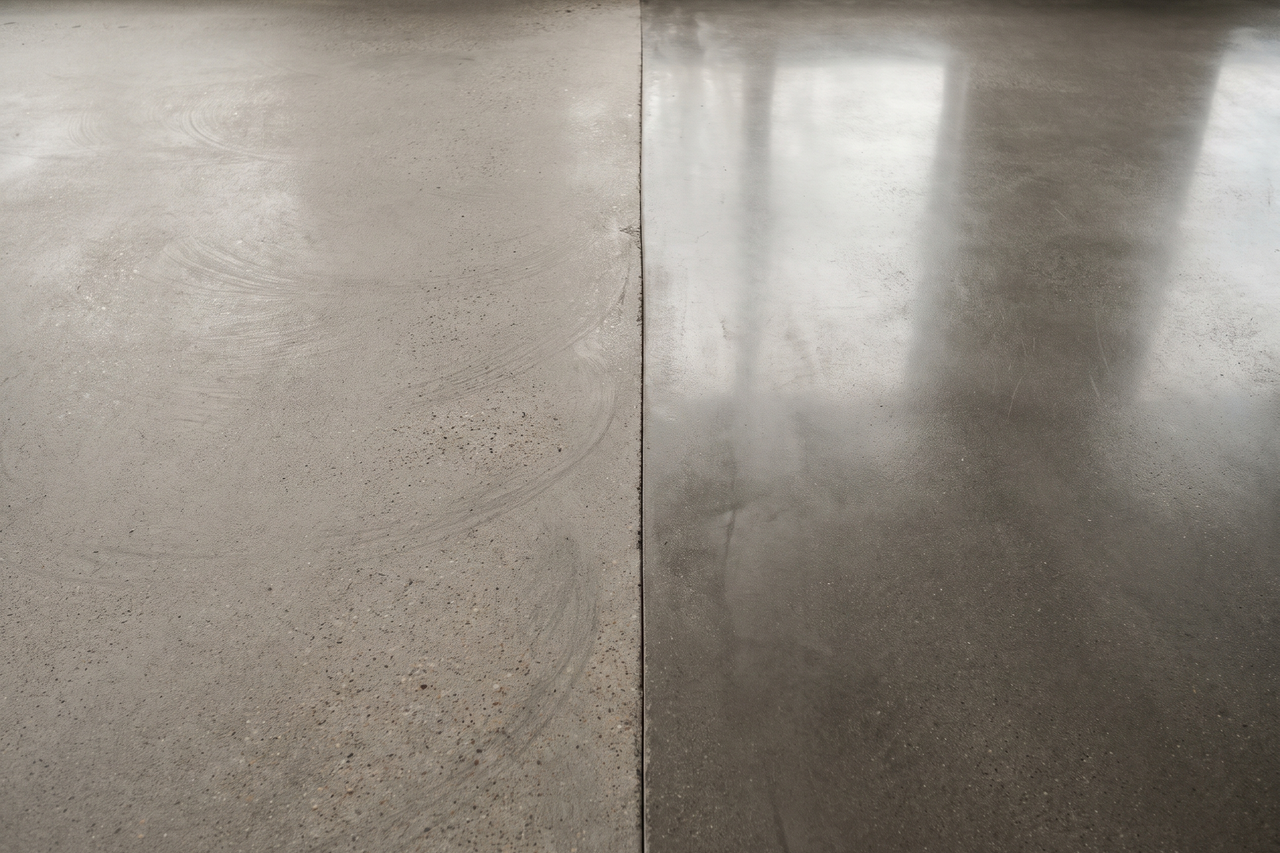
Epoxy and polyaspartic hold on by mechanically gripping a surface that is open and textured. Concrete that has never been profiled, whether it is sealed, polished or just left as poured, may look ready yet give the coating very little to bite into.
Professional preparation relies on two mechanical approaches. Diamond grinding moves abrasive tooling over the floor, cutting away the surface skin and exposing the coarse stone in the mix for a rough, open finish. Shot blasting drives steel shot into the concrete to create a comparable profile through impact. Both give the coating a surface it can lock onto, and which one suits a given job depends on the slab and what the product calls for.
The right profile depth changes with the coating and the condition of the slab. Your installer sets that target once the floor has been evaluated and before any machine is switched on.
Should Cracks Be Repaired First?
Repairs come ahead of coating for a straightforward reason. Material laid over an open crack adheres to both edges but to nothing in between, leaving the coating stretched over a gap rather than supported by solid concrete. Routine loads and temperature changes focus stress on that weak span, and the crack may eventually show up in the finished surface.
The correct repair depends on why the crack formed. A thin crack that has not moved is handled as ordinary preparation. Cracks that keep shifting, cut far down through the concrete or trace a line that suggests structural load or a settling slab are a separate case, and what is driving that movement needs answers before any repair material gets picked.
Our repair page for damaged coatings walks through how typical crack types are assessed and which approaches suit each.
Why Is Moisture Testing Important?
The ground beneath a slab is rarely dry. Its moisture moves up through the concrete as vapor, and when it reaches a sealed coating it is trapped. Pressure gathers right where coating meets concrete and presses the film from underneath, and the result may be bubbles, blisters or areas separating from the slab.
Testing moisture before products are selected bases those choices on measurements. Different coatings tolerate high vapor levels differently, and if readings are elevated a moisture-mitigating primer beneath the primary coating may make sense, a decision supported by numbers instead of a hunch.
Picking products with no moisture data means relying on assumptions. If those turn out to be wrong, moisture can become one of the reasons a coating fails early, together with preparation, coating selection and installation conditions.
Can Epoxy Go Over Painted or Previously Coated Concrete?
Coating over an existing layer depends on three things: identifying what that layer is, confirming how firmly it is attached and making sure the old and new products are compatible.
An existing coating that is already letting go, curling at its edges, bubbling or flaking off with light pressure, cannot be trusted as a base. A fresh coat on top simply carries that weakness forward instead of resolving it.
Where the old layer is firmly bonded and compatibility checks out, going over it may be an option. Figuring out exactly what is on the concrete is one of the reasons for a preparation assessment.
How Should You Prepare Your Garage Before the Contractor Arrives?
Grinding, repairs and moisture testing belong to the flooring professional. Your most useful contribution is a cleared space and any observations about the floor that could help with the evaluation.
Before-work checklist:
- Clear cars, storage bins, tools and everything else from the floor so every part of the slab is accessible.
- Mention any signs of moisture you have noticed, such as damp patches after storms, a white crusty film on the concrete or spots that feel spongy. Details like these help direct the assessment.
- If paint or a coating was ever applied to the floor, share what you know about it, even if your information is only partial.
- Ask ahead of work how the job will be ordered and what the plan is for getting the space back into normal use.
To follow the coating process from bare slab to finished surface, see our walkthrough of how an epoxy floor is installed.
Frequently Asked Questions About Concrete Preparation
How much difference does slab preparation make to coating performance?
A large one. Preparation is often part of the problem in early coating failures, alongside moisture, coating selection and installation conditions. Without proper profiling, cleaning and repair, a coating is missing the mechanical grip it depends on, whereas thorough preparation gives a better foundation for long-term performance.
Does every concrete floor get the same prep?
No. A clean slab with no previous coatings, minimal contamination and normal moisture readings is nothing like a floor showing all three problems. Your installer builds the preparation plan around what this particular floor reveals, not a one-size routine.
Is a slab with many cracks a problem?
What kind of cracks they are matters more than the count. Stable hairline cracks are typically folded into routine preparation with little effect on scope. Cracks that appear to be moving, go deep or line up with load or settlement patterns call for a closer, individual look before a repair material is chosen.
How does acid etching compare with diamond grinding?
Grinding has become the norm for most professional systems now in use, while etching is regarded as less predictable. It tends to leave an uneven profile, plus a residue that needs to be fully cleared before any coating goes on. Your installer selects the approach that fits the slab and the product.
When is newly poured concrete ready for a coating?
A commonly cited guideline is roughly 28 days of curing before new concrete is coated, but that figure is a rule of thumb, not a firm requirement. Real readiness hinges on the concrete mix, the temperatures during curing and the coating product chosen. Your installer verifies that the slab is ready before preparation starts.
What happens if moisture readings come back high?
High readings shorten the list of suitable products; they do not necessarily rule out coating. Your installer leans on the numbers to narrow down products, and where vapor readings run very high, a moisture-mitigating primer beneath the primary coat may be suggested, a step the test data itself supports.
Ready to Get a Quote for Your Concrete Floor in Lebanon, MO?
No two slabs share the same history or condition. Tell us how yours looks today to request a customized estimate.